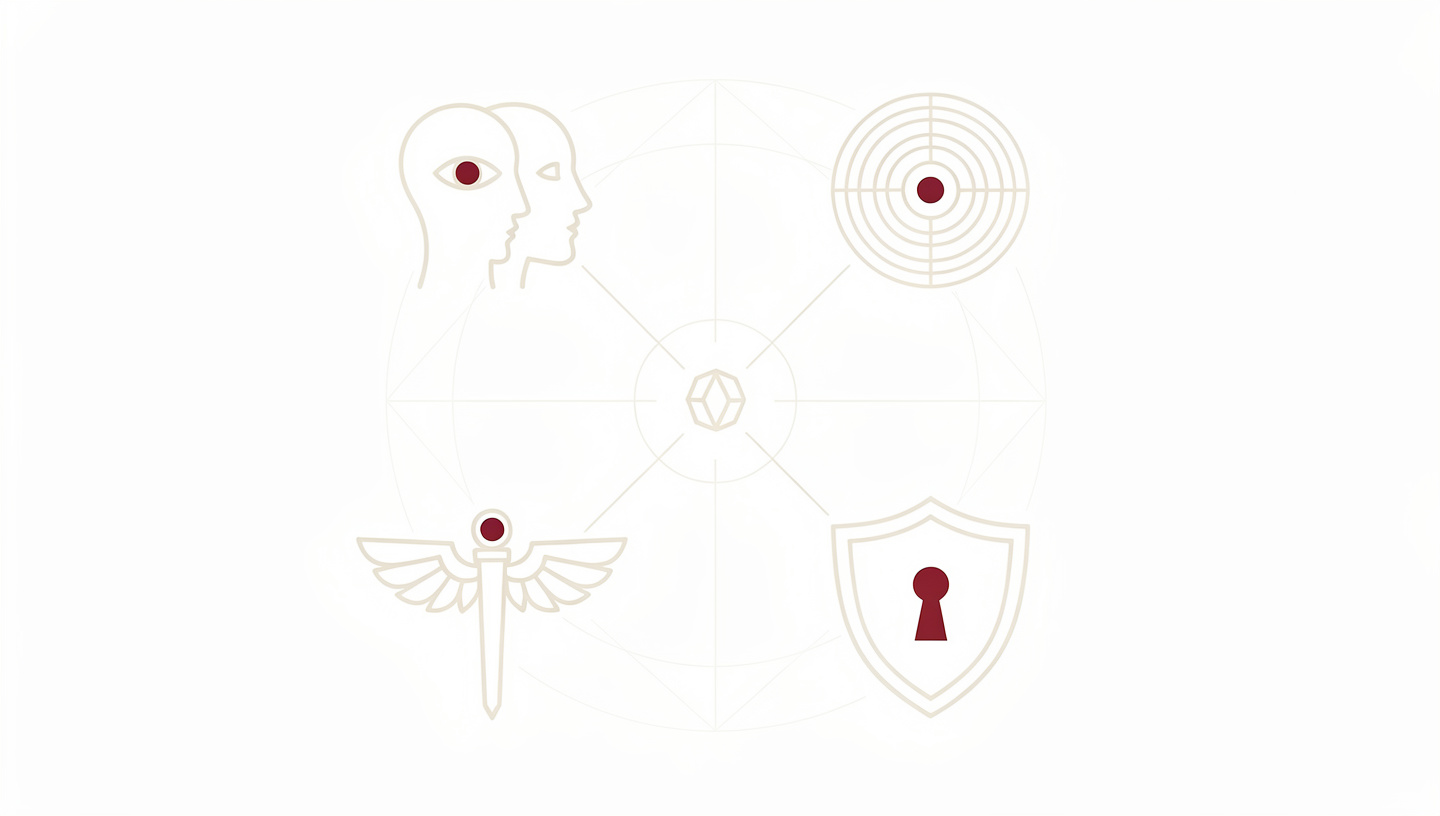
Two Red Kites is a Brisbane software consultancy that built four specialist AI systems. Janus for development, Gaia for design, Hermes for marketing, and Soteria for security, instead of hiring a larger team. These systems let a small group of senior engineers deliver the breadth and quality of a much larger firm. This post explains why we took that approach and what each system does.
There’s a standard playbook for growing a software consultancy. Win a bigger client, hire more developers. Need design work, hire a designer or subcontract a design agency. Client asks about security, bring in a penetration testing firm. Marketing? Another agency.
Before you know it, you’re coordinating five different firms, nobody owns the full picture, and the client is paying for the overhead of keeping everyone aligned.
We decided to do something different.
The Problem with Throwing People at Problems
When a large consultancy takes on a project, they assign a team: project manager, business analyst, a few developers (some senior, some junior), a QA tester, maybe a designer. If the project needs a security review, that’s a separate engagement with a separate team. Marketing optimisation? Another vendor entirely.
This model works. It’s proven. But it has three fundamental problems:
Coordination costs are invisible but real. Every handoff between teams (between the dev team and the security auditor, between the developer and the designer, between the PM and the client) introduces delay and information loss. The more people involved, the more time is spent making sure everyone is on the same page.
Junior developers are the margin. Large consultancies make money by billing junior developers at senior rates, or by having a few seniors supervise many juniors. The client pays for 10 people but gets the output capacity of 4 experienced ones.
Breadth requires multiple vendors. A development agency doesn’t do penetration testing. A security firm doesn’t do marketing. So the client ends up managing three or four relationships, three or four invoices, and three or four firms that don’t talk to each other.
| Traditional multi-vendor | 2RK integrated systems | |
|---|---|---|
| Coordination | Client manages 3–4 vendors | One team, one relationship |
| Review cycles | Sequential, week by week | Parallel, in one pass |
| Security scope | Separate engagement, months later | Integrated into every delivery |
| Who writes the code | Mix of juniors and seniors | Senior engineers only |
| Breadth of expertise | Requires additional vendors | Carried by the systems |
What We Built Instead
We’ve spent the last three years building four specialist AI systems that handle the functions traditionally requiring separate teams or vendors.
Janus: Development Orchestration
When code is written on a 2RK project, it doesn’t go through a single reviewer skimming a diff. Janus reviews each change against the full codebase and its documentation, not just the lines that changed. So every reviewer works with the same context a senior engineer would build up over weeks on the project.
Five specialist agents analyse the change in parallel, each tuned for the most common mistakes in their discipline, a software architect checks the design against existing patterns, a security engineer probes for the vulnerability classes that actually ship, a QA specialist verifies test coverage where it matters, a UX reviewer catches interface regressions, and an SEO engineer validates search optimisation. Their findings are compiled into a single brief.
A senior engineer then makes the final call on that brief, accepting, rejecting, or redirecting each finding against their own judgement. AI surfaces the issues using the pre-built project context; a human always signs off. In a traditional agency, these reviews happen sequentially if they happen at all, architect on Monday, security on Wednesday, QA on Friday. With Janus, they happen in parallel, and a human reviewer reads one structured brief instead of five scattered comment threads.
Janus also enforces our development workflow: five phases from setup to merge, with safety guardrails that prevent the kinds of mistakes that cause late-night production incidents. Mandatory code review before merge. Automated backup before any destructive git operation. Every task tracked from ticket to deployment.
Gaia: Design Intelligence

Gaia understands that a dashboard for a water treatment plant needs different design patterns than an e-commerce storefront. It has 10 built-in context patterns (SaaS applications, BI dashboards, e-commerce, documentation sites, and more), each with appropriate layout, typography, and interaction principles.
For new projects, Gaia produces working prototypes in days, not weeks. Not Figma mockups: real, deployable code with proper accessibility (WCAG 2.1 AA by default) and responsive design. See examples of this in our case studies.
For existing applications, Gaia can modernise the user interface without touching the backend logic. It detects whether the app uses Bootstrap or Tailwind and works within the existing framework. The result is a modern face on a proven foundation.
Hermes: Marketing Systems

Marketing for a software company shouldn’t be ad hoc. Hermes provides 33 structured workflows. SEO audits that tell you exactly what’s broken and how to fix it. Content strategy that maps topics to where your buyers are in their decision. Conversion rate optimisation that finds the friction on every page.
When we run an SEO audit, it’s not a person spending two days clicking through pages. Hermes systematically checks every technical SEO factor, every on-page element, every schema markup issue, and produces a prioritised action plan. The same thoroughness applies to content strategy, competitor analysis, analytics tracking, and email sequences.
Soteria: Security Assessment

Security testing shouldn’t be something you do once a year when the compliance deadline approaches. Soteria runs a three-phase penetration test: reconnaissance to map the attack surface, deep vulnerability scanning against known CVE databases, and active exploitation testing that actually probes for weaknesses.
The output is a professional report with semaphore severity ratings, red for critical, amber for medium, blue for low, with specific remediation steps for each finding. Not a generic “you should improve your security posture” recommendation, but “this header is missing on these pages, here’s the exact configuration to add.”
What This Means for Clients
The practical outcome is straightforward: a small team of senior engineers delivers the breadth and quality that traditionally requires a much larger firm.
See our full range of services to understand what this covers.
When you work with us, you get:
And you get it from the people who actually do the work. No project managers relaying messages. No account managers translating requirements. No junior developers learning on your project. Direct access to the senior engineers who built these systems and use them every day.
The Trade-Off
We should be honest about what this model doesn’t do.
Tight deadlines aren’t the issue, a small senior team backed by our AI systems typically outperforms same-size mixed teams, and we routinely move faster than firms with more bodies on the problem. Speed isn’t where we hit the wall.
The wall is raw scale. If you’re building a multi-million-line codebase, or running a multi-year programme that genuinely needs dozens of engineers permanently working in parallel, a large consultancy is the right fit. No AI system compensates for the sheer surface area of a project at that scale.
For everything short of that, mid-market businesses that have outgrown their current tools, product lines inside larger companies, founders building to graduate, our model covers more ground per headcount because the systems carry the breadth. Development, design, security, and marketing: integrated, not siloed.
Why We’re Sharing This
We considered keeping this quiet. The systems are a competitive advantage, and explaining how we work gives competitors a blueprint.
But we’ve found that clients who understand our approach trust us more, not less. They can see that the quality of their code review, security testing, and marketing optimisation comes from systems refined over years. Not from a lucky hire or a good week.
And frankly, building these systems isn’t something you do over a weekend. They represent years of refinement across 11+ industries and over a decade of client delivery. Knowing they exist doesn’t make them easy to replicate.
If this approach resonates with how you want to work, senior people, specialist systems, direct communication, we’d like to hear from you.
Frequently Asked Questions
What are Janus, Gaia, Hermes, and Soteria? They are four purpose-built AI systems created by Two Red Kites. Janus orchestrates development with 19 specialist agents providing parallel code review. Gaia handles design with 10 industry-specific patterns and produces working prototypes in days. Hermes provides 33 structured marketing workflows for SEO, CRO, and content. Soteria runs three-phase automated security assessments with professional reporting.
How does AI-powered code review work? Janus reviews each change against the full codebase and its documentation, not just the diff in isolation. Five specialist agents analyse the change in parallel from different angles (architecture, security, QA, UX, SEO), each tuned to catch the most common mistakes in their discipline. Their findings are compiled into a single brief that a senior engineer uses to make the final call. AI surfaces the issues using the pre-built project context; a human always signs off.
Is this approach suitable for large projects? Tight deadlines aren’t the limit, a small senior team backed by our AI systems typically outperforms same-size mixed teams, so we can move faster than many firms of our headcount. The real ceiling is raw scale. If you’re building a multi-million-line codebase or a multi-year programme that needs dozens of engineers permanently working in parallel, a large consultancy is genuinely the better fit. For everything short of that, our model holds up.
Where is Two Red Kites based? Brisbane, Australia, with a 100% Australian team. Over 60% of clients are outside Queensland, serving businesses nationally.
Book a free 30-minute call →. No pitch, no obligation, just straight answers from the people who’d work on your project.

Daniel Z
Technical Lead · Two Red KitesTechnical Lead at Two Red Kites. Sits at the intersection of engineering and strategy: leading the team, setting technical direction, building internal developer tooling, and staying hands-on with the code across FinTech, HealthTech, Construction, and SaaS projects.