

AI has collapsed the cost of writing code, and therefore the cost of rewriting it. That changes everything about how to think about technical debt. Deliberately taking on technical debt to validate an idea quickly, then rebuilding once demand is proven, is now a sound strategy, not a shortcut. We call this the AI slope.
For a decade, the software industry treated technical debt like financial debt: something to avoid, minimise, and pay down as quickly as possible. Teams ran refactoring sprints. Architects drew dependency diagrams. Conference speakers warned about the compounding cost of shortcuts.
They were right. In that era.
But the economics of building software have fundamentally changed. AI has collapsed the cost of writing code. And when the cost of writing changes, the cost of rewriting changes too. That shift turns a principle we held sacred, avoid technical debt, into something more nuanced: technical debt is now a strategic tool, if you know when to take it on and when to pay it off.
The AI slope is the practice of building software with AI-assisted speed while maintaining deliberate control, moving fast downhill, but choosing your line.
“If You Can’t Afford to Build It Right, You Can’t Build It Twice”
There is a line that gets repeated in every architecture meeting and every sprint retrospective: if you do not have the money to build it right once, you definitely do not have the money to build it twice.
The traditional argument behind it was sound. Code was expensive to write. A shortcut taken in month one became a constraint in month six. By month twelve, the shortcuts had compounded into a codebase that resisted every change. Teams spent more time working around past decisions than building new features. Security vulnerabilities accumulated in code nobody wanted to touch.
Rewriting was worse. Understanding the original decisions, untangling the dependencies, migrating the data. It took longer than writing the feature the first time. Building twice was not a strategy. It was a budget overrun.
So the response was reasonable: plan carefully, build correctly the first time, minimise debt at every turn.
But that saying assumed something that is no longer true: that writing code is the bottleneck.
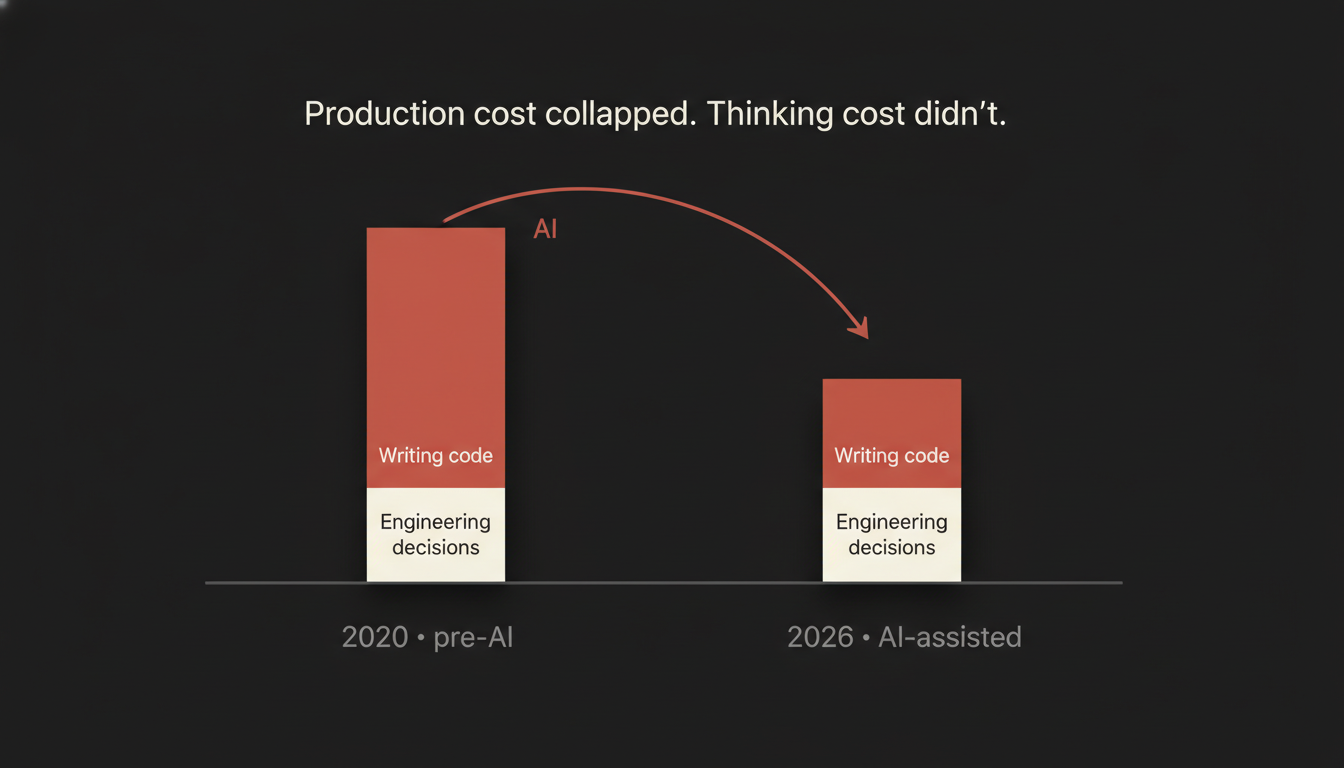
The New Economics: Code Is Cheap, Engineering Is Not
AI has collapsed the cost of writing code. Not the cost of engineering, the thinking, the security decisions, the architecture choices, the judgment about what to build and why. That part is as expensive and as human as it ever was. What changed is the production cost. The typing. The boilerplate. The first draft.
This distinction is everything. Engineering is not being replaced. The senior developer who decides how authentication should work, who spots the race condition in the payment flow, who knows that the naive database query will fall over at scale. That person is more valuable than ever. AI does not do their job. AI does the job that used to occupy most of their time: turning decisions into working code.
When code is cheap to produce, it is cheap to throw away. And when throwing away code is cheap, building twice stops being a failure and starts being a strategy.
A working prototype that validates whether customers actually want a feature is worth more than a perfectly architected feature that nobody uses. And if that prototype costs weeks instead of quarters, the calculus on technical debt flips entirely.
Build it once to learn. Build it again to last. The first version answers the question: does anyone care? The second version answers a different question: how do we serve them well?
You can now afford to build it twice, because the first build costs a fraction of what it used to, and the second build is informed by everything you learned from the first.
What Is the Difference Between Vibe Coding and AI-Oriented Development?
There is an important distinction to make here. We are not describing the practice of prompting an AI to generate an application and shipping whatever comes back. We have written in detail about why vibe coding produces fragile, insecure software.
AI-oriented development is disciplined. It accepts that some code will be thrown away, but it does not accept that security, usability, or system boundaries will be compromised. The difference:
Vibe coding skips engineering process entirely. No architecture. No security review. No testing. Ship the output, hope for the best.
AI-oriented development keeps the non-negotiables locked down and lets everything else move fast. The non-negotiables are:
- Security. Authentication, authorisation, data handling, input validation. These are never optional, not even in a prototype. A security breach in a prototype damages your brand just as badly as one in a mature product.
- A clean API boundary. The contract between your frontend and backend (or between your service and its consumers) needs to be right from the start. When you rebuild, the API is what stays. Everything behind it can change.
- User experience. If the prototype does not feel right to use, you have not validated the idea. You have validated that people will tolerate a bad interface for long enough to answer a survey. The UX is the experiment. It has to be real.
Everything else, the database schema, the internal service structure, the deployment pipeline, the test coverage depth, can be expedient in version one and rebuilt in version two. That is not sloppy engineering. That is prioritisation.
| Vibe Coding | AI-Oriented Development | |
|---|---|---|
| Security | Optional | Non-negotiable |
| API design | Ad hoc | Defined upfront |
| UX quality | Placeholder | Production-quality |
| Throwaway scope | Everything | Internal implementation only |
| Rebuild intent | None | Planned from the start |
What Is the Two-Build Strategy?
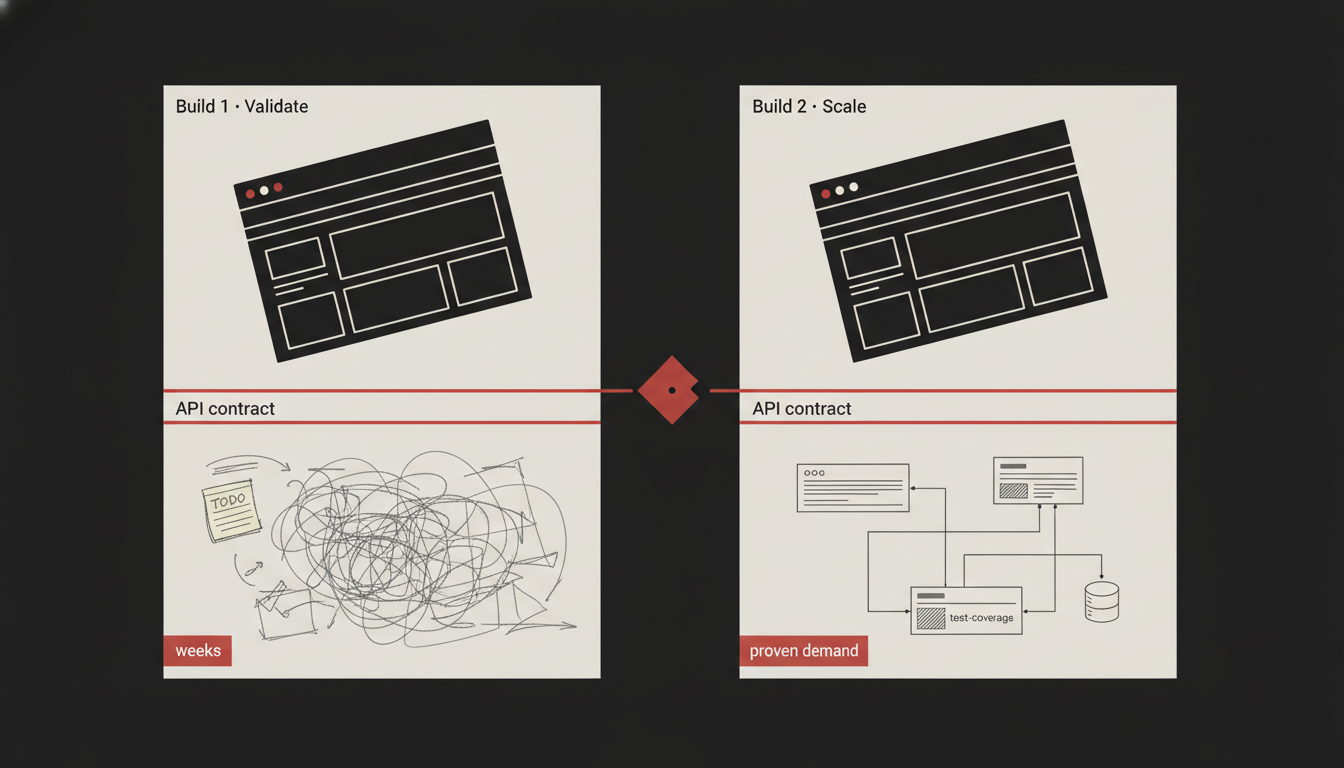
The practical application looks like this:
Build one: validate. Move fast. Use AI to produce working software in weeks, not months. Focus ruthlessly on UX, the interface the customer actually touches, and the API, the contract that systems integrate against. Ship to real users. Measure whether the idea has legs. Do people come back? Do they pay? Do they tell others?
This version will have rough edges internally. The database queries might be naive. The background jobs might be over-engineered or under-engineered. The admin interface might not exist. That is fine. None of those things affect whether the idea works.
Build two: scale. Once you know the idea is validated, real customers, real revenue, real demand, rebuild the internals with proper engineering discipline. Now the investment in architecture, performance, test coverage, and operational tooling has a known return. You are not guessing that the feature matters. You have proof.
The critical insight: the UX and the API survive from build one to build two. Your customers never see the transition. The external contract stays the same. Only the internals change.
This is not a theoretical framework. We do this with clients using Gaia, our design intelligence system. One of the four AI systems we built instead of growing a bigger team. Gaia produces working prototypes, real code, not mockups, in days. Clients validate with actual users. When the idea proves out, we rebuild the internals with Janus enforcing full engineering process: architecture review, security analysis, parallel code review, QA verification.
The prototype answered the business question. The rebuild answers the engineering question. Both are necessary. The order matters.
Talk to us about validating your next idea →. No pitch, just straight answers.




The Business Case for Technical Debt as a Strategy
The business value of this approach is straightforward.
Faster time to market. You validate ideas in weeks, not quarters. The first version is in front of customers while your competitors are still writing architecture documents.
Lower cost of failure. If the idea does not work, you spent weeks finding out, not months. The sunk cost is minimal. Move on to the next idea.
Higher confidence in investment. When you do commit to a full build, you have data. Real usage. Real revenue. Real user behaviour. The engineering investment is de-risked because the business case is already proven.
Better final product. The rebuild benefits from everything you learned during validation. The database schema reflects actual usage patterns. The API reflects real integration needs. The UX reflects real user behaviour. You are not guessing. You are building on evidence.
This is not an argument for lower quality software. It is an argument for investing in quality at the right moment, after the idea is proven, not before.
Frequently Asked Questions
Is this just vibe coding with a better name? No. Vibe coding ships AI output without process. AI-oriented development maintains security, clean APIs, and real UX as non-negotiables. The throwaway part is planned and bounded, not accidental.
When should you rebuild instead of iterating on the first version? When the idea is validated, paying customers, clear demand, established usage patterns. The first version answered whether anyone cares. The second version builds the business.
What parts of the codebase should never be throwaway? The user experience and the API contract. These are what customers and integrations depend on. Everything behind them can be replaced without anyone noticing.
How does Two Red Kites apply this approach? We use Gaia to produce working prototypes in days. Clients validate with real users. When the idea proves out, we rebuild internals with Janus enforcing full engineering discipline. The UX stays. The plumbing gets replaced.
Related Reading:
- The Problem With AI-Generated Code (And How We Solved It)
- Why We Built Four AI Systems (Not a Bigger Team)
Book a free 30-minute call →. We will show you how to validate your idea before committing to a full build.

Daniel Z
Technical Lead · Two Red KitesTechnical Lead at Two Red Kites. Sits at the intersection of engineering and strategy: leading the team, setting technical direction, building internal developer tooling, and staying hands-on with the code across FinTech, HealthTech, Construction, and SaaS projects.